Building Reliable Connectivity at Festivals: Challenges and Modern Solutions
Festivals have evolved far beyond music stages and food trucks. Today’s events depend on technology to manage operations, enhance attendee experiences, and maintain revenue streams. From digital ticketing and wristband scanning to live-streamed performances and vendor point-of-sale systems, connectivity underpins nearly every aspect of a successful festival.
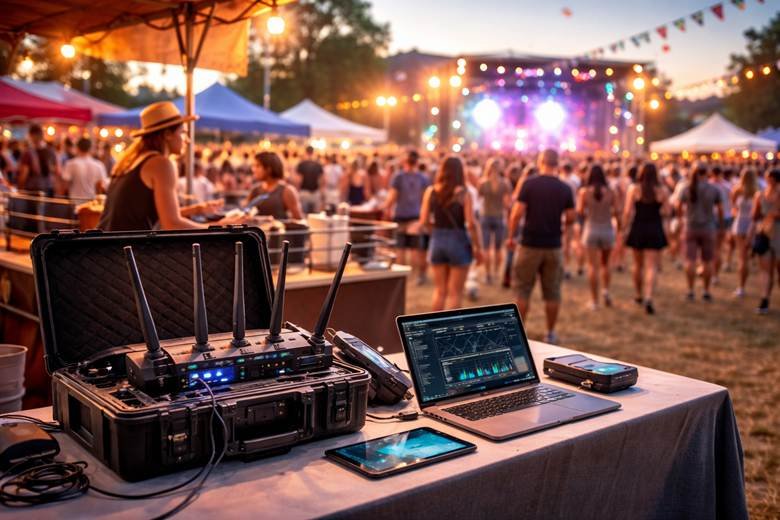
Yet providing internet in a festival environment presents challenges unlike those in conventional venues. Temporary networks must withstand unpredictable crowds, RF interference, environmental factors, and high bandwidth demand—all within a few days or even hours of setup.
The Technical Complexity of Festival Networks
Outdoor festivals introduce variables that complicate connectivity:
- Dynamic RF conditions: Tents, stages, lighting rigs, and even weather can affect signal propagation.
- High device density: Attendees carry multiple smartphones, tablets, and wearables, creating thousands of simultaneous connections in a small footprint.
- Variable traffic patterns: Live video uploads, app usage, and cloud-based ticketing generate sporadic bandwidth spikes.
- Limited infrastructure: Unlike convention centers, festival grounds rarely have built-in wiring, relying on temporary power and mobile internet.
Recent research from Parks Associates reports that over 85% of festival attendees expect stable, high-speed connectivity to access apps, share media, and make mobile payments. For a 30,000-person event, this translates into roughly 80,000–100,000 connected devices competing for bandwidth.
Why Traditional WiFi Often Falls Short
Many festival organizers initially attempt to rely on public WiFi or temporary hotspots. The limitations are clear:
- Unpredictable performance: Shared networks degrade quickly under high density.
- Slow upload speeds: Critical for streaming performances, media coverage, and vendor transactions.
- Security vulnerabilities: Open networks risk data interception and rogue devices.
- Minimal support: On-site teams often lack the capacity to troubleshoot temporary network failures in real-time.
A network consultant specializing in large outdoor events noted:
“Even with the best access points, outdoor festivals are unpredictable. Client density and interference make WiFi performance extremely variable without dedicated management.”
Festival-Specific Connectivity Demands
Different stakeholders place unique demands on festival networks:
- Vendors: Digital payment processing, inventory management, and POS systems depend on consistent connectivity.
- Organizers: Ticketing dashboards, staffing coordination, and emergency communication rely on real-time data.
- Media teams: High-bandwidth upload requirements for live streaming and social media content.
- Attendees: Expect festival apps, mobile ordering, interactive experiences, and reliable social media access.
These demands require networks that go beyond consumer-grade solutions and even beyond standard event WiFi.
Portable and Cellular-Based Solutions
TradeShowInternet’s festival WiFi solutions exemplify how portable, pre-configured kits meet these demands. They rely on carrier-bonded LTE/5G technology, creating independent networks that operate apart from public or venue infrastructure.
Advantages include:
- Predictable bandwidth: Dedicated networks for vendors and staff reduce contention with public traffic.
- Rapid deployment: Pre-configured kits can be installed within an hour, minimizing setup logistics.
- Security control: Firewalls, private SSIDs, and encryption protect sensitive transactions.
- Mobility: Kits can be relocated across stages, VIP areas, and temporary offices.
These systems essentially act as temporary mobile nodes, with the capability to handle thousands of simultaneous connections in dense outdoor settings.
Data-Driven Network Design
For festival network engineers, several metrics guide deployment:
- Client count per AP: Ensures no single access point is overloaded.
- Bandwidth per device: Upload-intensive tasks like live streaming often dictate uplink capacity.
- Coverage mapping: Terrain, tents, stages, and crowd movement affect signal distribution.
- Redundancy and failover: Bonded carriers maintain uptime if one network experiences congestion.
GSMA reports that multi-carrier solutions can achieve consistent upload speeds of 10–15 Mbps per device for enterprise clients, even under high-density conditions. For vendors and organizers, reliability outweighs raw peak speed, making bonded solutions preferable to venue WiFi.
Security and Compliance Considerations
Festival networks often handle sensitive data, including credit card transactions and personal attendee information. Open or poorly segmented networks increase exposure to:
- Man-in-the-middle attacks
- Rogue access points
- Accidental data leakage
Portable systems allow organizers to implement private VLANs, enterprise-grade encryption, and firewall policies. Compliance with PCI DSS for payment processing is easier when network control rests with the event team, rather than a shared venue network.
Operational Flexibility and Cost Management
Portable solutions offer additional benefits:
- Scalability: Units can be deployed incrementally depending on crowd size or vendor requirements.
- Predictable costs: Rental fees for kits are fixed, avoiding unexpected venue surcharges.
- Ease of teardown: Kits are designed for rapid post-event removal.
- Continuous use: Equipment can be reused for multiple festivals or temporary events.
For multi-day festivals, these operational advantages are critical. Organizers can focus on the attendee experience rather than troubleshooting network issues.
Emerging Trends in Festival Connectivity
Festival networks are evolving to support:
- IoT integration: Smart wristbands, interactive installations, and environmental sensors.
- Hybrid experiences: Remote streaming of performances for online attendees.
- Real-time analytics: Monitoring crowd density, vendor performance, and network load.
- High-bandwidth applications: AR/VR experiences and live interactive content.
These trends further emphasize the need for reliable, portable, carrier-bonded connectivity.
Providing reliable internet at festivals is a complex challenge, involving high-density clients, variable environments, and mission-critical applications. Portable and cellular-based solutions address these issues by offering predictable performance, security, and flexibility.
Organizations that deploy these systems—such as festival WiFi & internet connectivity solutions by TradeShowInternet— that can ensure connectivity for vendors, staff, media, and attendees alike. TradeShowInternet is a provider of internet access for events, offering portable, high-density WiFi solutions capable of supporting large-scale outdoor events and multi-day festivals.